Extracts from the Conversation - Demonology
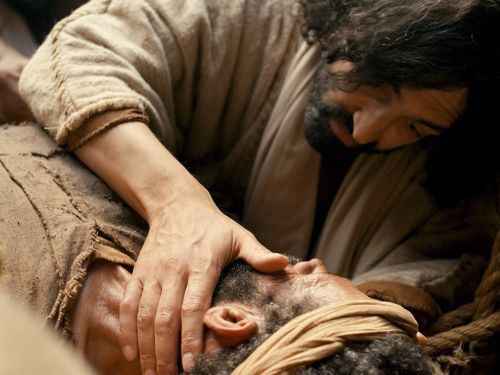
Courtesy of Lumo Project Films – www.lumoproject.com
Most people today don’t believe in a devil and evil spirits, and certainly they don’t believe that demons afflict people with all sorts of medical conditions. Yet out of respect for the Christian heritage and for Jesus and his followers we must acknowledge that the NT writers all believed in Satan and demons. Evil spirits were seen as enemies of God and tormenters of the suffering individuals afflicted by them.
In our reading today, Jesus sent seventy-two disciples out to heal the sick to announce the kingdom of God. When his disciples returned, they reported: “Lord, even the demons submit to us in your name.”
Referring to his pre-human existence and a passage in Isaiah 14:12, Jesus responded, "I beheld Satan fall as lightning from heaven." [Luke 10:18] (Several OT passages carry the theme of angelic rebellion, Ezekiel 28:12-19, Psalms 82:6-7, Job 4:18 and 15:15 and Daniel 10:13 & 20.)
The second letter of Peter also mentions the fate of fallen celestial beings. “God did not spare angels when they sinned, but sent them to hell…” [2 Pet.2:4] One of the most fascinating overlaps in apocalyptic literature, is the Book of Revelation which borrows from the imagery, themes, and structure of 1 Enoch. (1 and 2 Enoch an apocalyptic non-canonical document written somewhere between 300 to 100 BCE)
Rev.14:14 “One like a ‘son of man’ with a golden crown…” resembles 1 Enoch 46-48, where the “Son of Man” is portrayed as a pre-existent, divine judge. There are obvious parallels in Rev.1:16 & 20, Ch’s 4-5, 9:1-11, 12:7-9, 20:1-3 & 21-22.
Jesus’ apocalyptic teaching and judgement parables also resemble 1 Enoch, and the cosmic signs in Matthew 24 are clearly sourced from 1 Enoch 1:5-9 and 62-63. Paul’s readers were obviously familiar with Enoch when he writes in his 1st Corinthian letter Ch. 6:3: “Do you not know that we will judge angels?”
In pagan mythology and pre-dating Judeo-Christian thought, ancient stories portray a rebellion of divine beings which were later incorporated into Christian theology. In the OT are fragments about the insurrection of prideful heavenly beings cast from heaven and awaiting final punishment. Pagan myths about gods in conflict contrasts with Jewish/Christian monotheism that anticipates the one supreme God will ultimately punish rebellious angels, “bound in chains in gloomy darkness.” [2 Peter 2:4 & Jude 6]
“Our struggle,” he continues, “is not against flesh and blood, but against the rulers, against the authorities, against the powers of this dark world and against the spiritual forces of evil in the heavenly realms.” Paul’s ‘spiritual warfare,” is consistent with the Hebrew tradition that evil is neutralised by the chalebi worn by women. "The chalebi, the old traditional head-dress of the Jewish women, invented for the express purpose of keeping off the Schedim, who sit on the hair of women whose heads are uncovered " [Farrar, Life of Christ Excursus vii] In Jewish mythology, ‘Schedim’ were demon-like spirits in the air that also haunted solitary places and sepulchres. These angels of evil were believed to frequent crowded assembles and the reason Paul taught women to cover their heads - “because of the angels.” [1 Cor.11:10]
Jesus’ compassionate demonstrations of kingdom power were not without drama, demons came out shouting and claiming to know who Jesus was – in other words, they recognised his divinity. An example is in the exorcism in the synagogue when Jesus began to teach. Just then a man in their synagogue who was possessed by an impure spirit cried out, “What do you want with us, Jesus of Nazareth? Have you come to destroy us? I know who you are—the Holy One of God!” “Be quiet!” Jesus commanded “Come out of him!” and “The impure spirit shook the man violently and came out of him with a shriek.” [Mark 1:22-25]
“You are the Son of God!” shouted two demoniacs, but Jesus rebuked them and would not allow them to speak, because they knew he was the Messiah.” [Luke 4:41]
All this was at a time when sickness and the causes of disease, illness and mental health issues was unknown. Belief in demon possession was a way of explaining suffering and accounts for why exorcism was such a major theme during Jesus’ ministry.
Knowing nothing of psychology, neurology, viruses and infections, people imagined the world as a battleground between God and the forces of evil. Jesus talked all the time about the kingdom of God, when the “present age” dominated by evil powers would be overthrown and a new age of utopian peace would begin. “If I drive out demons by the finger of God, (he said) then the kingdom of God has come upon you.” [Luke 11:20 & Matt.12:28]
Many Christian churches still practice exorcism; the Catholic Church has a formal Rite of Exorcism. The Eastern Orthodox, Anglican Episcopal, Pentecostal, Charismatic, Lutheran and Reformed/Presbyterian all have rites of exorcism both formal and informal prayers of deliverance.
In these healing stories we see Jesus’ compassionate response to people’s suffering at a time when there was no correct diagnosis or medical care. The story of a distressed father and his convulsing son tells of the heart wrenching desperation typical of those who came to Jesus asking for a miracle. [Mark 9:22-23]
Exorcisms and healing miracles demonstrated the power of the kingdom, God’s love and Jesus’ compassion, no wonder the people responded and many believed in Jesus.