“Do you think I came to bring peace on earth? No, I tell you, but division.” If ever Jesus made an enigmatic statement this must be it.
Described as the ‘Prince of Peace’ who taught ‘blessed are peacemakers,’ this mysterious statement clearly conflicts with his non-retaliation, “turn the other cheek” teaching. What is the explanation for this anomaly?
As I’ve explained before, most of the New Testament is a collection of quotes, paraphrases, references and illusions to passages in the Old Testament. Our reading for today is drawn from Micah 7:6 where we read:
“For a son dishonours his father, a daughter rises up against her mother, a daughter-in-law against her mother-in-law—a man’s enemies are the members of his own household.”
Jesus’ words are not a translation of these ancient words, but an echo of them that the people listening would have known came from the prophet Micah. The same story is in Matthew 10:34, where translators used the word ‘sword’ instead of fire.
“Do not suppose that I have come to bring peace to the earth. I did not come to bring peace, but a sword.”
Here the word ‘sword’ is used as a metaphor that indicates a time of great upheaval and division. A text without a context is easily misinterpreted, and this shocking passage must be read within its historical framework. Speaking from an apocalyptic world-view Jesus predicts a time when there would be so much division that families would be divided and there would be rampant societal distrust. Just as the prophets before him had spoken, he warned that the destruction of Jerusalem was imminent. And when his disciples admired the magnificence of temple, he cited no less than four Old Testament prophecies that predict destruction in the first temple period. (Micah 3:12, Jeremiah 26:13 which itself quotes Micah 3, Lamentations 2:8-9 and Daniel 9:26) Jesus uses similar wording to these Old Testament scriptures when he refers the destruction of the second temple, “There will not be left here one stone upon another.” [Matt. 24:2] The ‘Wailing Wall’ in the old city of Jerusalem is all that stands of Herod’s temple.
We know Jesus didn’t advocate violence so how are we to understand his disappointment that he is not leading a revolt and causing division? He spoke in striking images, powerful metaphors, to describe the turmoil and division his mission would bring. Because his message was radical and counter-cultural, his message of love and non-violence has for centuries had the effect of stirring up trouble and splitting families and communities. Just as fire in scripture symbolises purification, so too did Jesus’ teaching spark a refining, revealing the truth. So, when he said that he came to bring division, we can interpret his disappointment, that it’s not happening sooner, as his deep yearning that his mission be fulfilled and not delayed.
As with many of his riddles and paradoxical sayings, Jesus warning message is veiled.
“When I sent you without purse, bag or sandals, did you lack anything?” “Nothing,” they answered. He said to them, “But now if you have a purse, take it, and also a bag; and if you don’t have a sword, sell your cloak and buy one.
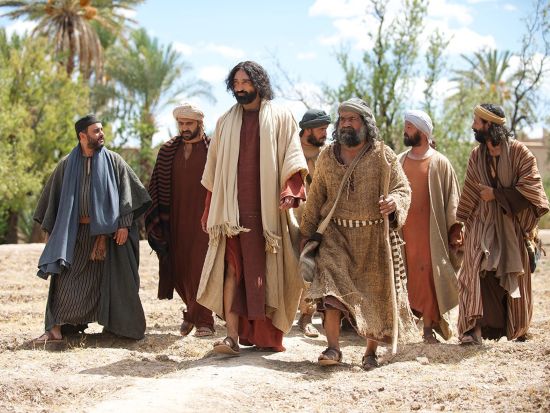
Courtesy of Lumo Project Films – www.lumoproject.com
The disciples, because they took his words literally, did not understand his true meaning and they said to him, “See, Lord, here are two swords,” to which Jesus replied, perhaps with frustration, “That’s enough!” [Matt.22:35-36, 38] Strange as it seems to us, Jesus’ disciples who were predominately fishermen carried swords while following a master who taught ‘love thy neighbour’. When the Roman soldiers “stepped forward, seized Jesus and arrested him, one of Jesus’ companions reached for his sword and struck the servant of the high priest, cutting off his ear. [Matt. 26:50-52]
During the Roman occupation, most men were unemployed and ganged together to rob and steal what they needed to live, and others wandered the countryside following ascetics relying on the charity of others. Divided into many different sects with bitter rivalry between the various groups, the people were also fearful of the religious leaders because they collaborated with the Romans.
Into this tension came Jesus preaching the kingdom of God and exposing the corrupt religious leaders. The fires of rebellion and revolt had ignited many times before his birth and were about to ignite again at any moment. The Aramaic text reads: “I am come to set the earth on fire; and I wish to do it, if it has not already been kindled” (v. 49). “To set the earth on fire” is a Semitic idiom which means “to upset, stir up trouble, or to disturb its peace.” When taxes are too high Middle Eastern people say, “the government is burning us.” The expectation of something big about to happen was high and Jesus’ followers were beginning to think, just maybe he was the long-expected Messiah. He certainly talked that way.
In the Olivet Discourse, the disciples asked Jesus when the catastrophe would happen, but again he gave a veiled answer. Instead he warned about false messiahs and wars that there would be earthquakes, famines, and persecutions as a sign, but “The end is not yet,” and no one knows not even himself. Jesus clearly spoke of the wars of 70 CE, not the end of the age some distant time in the future, because he said that some of his followers would be alive when the catastrophe occurred.
Some of you who are standing here will not taste death before they see the Son of Man coming in his kingdom. [Matt.16:28]
In the year 70, under the emperor Titus Jerusalem was sacked and the temple destroyed to quash the Jewish uprising that had begun four years earlier.
As history has proved, this historic event was not enough to satisfy the ancient prophecies, and the expectation of an apocalypse at the end of the age persists today. For centuries, ancient apocalyptic writings have fuelled a minefield of interpretations and left in its wake a history of failed predictions. The letters of Paul indicate the early church gradually came to realise the so-called ‘end’ would not take place within their lifetimes, and the early Christian community began to adopt hierarchical Greco-Roman structures for church governance. This shift from imminency to a longer-term view had significant influence on the development of Christian theology.
To this day, Jesus’ message still causes division, yet with amazingly diverse interpretations of his teachings and ways of worshipping people’s lives are still being changed. A saying attributed to Jesus dubbed the ‘Golden Rule,’ is found in all the major faiths and just about everyone believes in the principle whether they are religious or not.
“In everything, do to others what you would have them do to you. . .
” [Matt.7:12]
We all agree that to love others whatever they believe, and to try to understand them and their cultures is the only way forward in human relationships. We must learn to listen to each other and appreciate how others think and how they choose to live.
As I’ve often said, let’s help those who don’t feel comfortable in a church feel comfortable in our church. Someone said to me after a funeral service we hosted some years back, “My heart is full.”
I can’t think of a better way for us to be the Church in our community, than to fill people’s hearts with love and acceptance, whether they come on Sunday or they don’t.