Our attention this week is drawn again, to Jesus’ rejection of entrenched traditions that diminish and suppress some people while elevating and empowering others.
In human society, those with power and recognition systematically use their authority to intimidate and dictate terms that favour them at the expense of others who are perceived as being at a disadvantage. We see this in small organisations, in large corporations, and not immune from politicking, we see it in churches because where there is power, there is the opportunity to intimidate others with less influence.
Greco/Roman and Jewish cultures were full of hierarchies and exclusions that went beyond but included gender inequality. The suppression of women was ingrained in society with women excluded from formal education, their legal status limited, and females restricted in synagogue and temple worship.
In a society that silenced women, Jesus consistently gave voice, authority, and spiritual dignity to females. How did he do this?
He engaged in public conversations with women, prevented the stoning of a woman, included women among his disciples and patrons, healed and dignified marginalised women, and elevated females as faith exemplars. Jesus actively crossed cultural boundaries and challenged the limitations that society placed on women.
The story of Mary and Martha has for centuries been used to encourage Christians to prioritise their time, but that take on the story fits more with Western society than it does with the 1st century.
To understand the implications of the conversation between Martha and Jesus we must explore the context or risk missing the social dynamic of their weighted exchange. We begin with Martha inviting Jesus and his disciples to her home, but with so many guests to feed and cater for Martha became overwhelmed and “worried and upset about many things.” Mary on the other hand, had left her sister to serve alone and was ‘sitting at the feet’ of Jesus with the men.
In this story Mary has been upheld for her devotion, but there’s a lot more going on than devotion and having the right priority. Feeling resentful, Martha complains directly to Jesus, which itself was culturally inappropriate because women didn’t address men.
What does her boldness indicate?
It shows that Jesus had already demolished gender restrictions in his relationship with women, and that it was ok for her to speak, but her complaining was much more than a household squabble (Elisabeth Schũssler Fiorenza). In Jewish culture, sitting at the feet of a rabbi was an expression that described the formal relationship between teachers of Torah (the first 5 books of the Old Testament) and their students.
Rabbis had ‘Talmidim,’ that is, disciples who accompanied them wherever they went to learn scriptures and imitate their leader and his way of life. The term ‘rabbi’ was a broad term meaning ‘great one’ or ‘my master,’ and was applied to Jesus by his disciples and others, even by Judas Iscariot as he betrayed him. Jesus was called Rabbi because of his insightful teaching, extraordinary understanding of Scripture, and because he challenged the hierarchical society that oppressed the common people. Mark 1:22, The people were astonished at his teaching, for he taught them as one having authority, and not as the scribes.” More than 3,500 parables from 1st century rabbis exist today, and Jesus' parables are recognised by scholars as among the most profound.
We are glimpsing into an ancient culture, so what did “one having authority” mean?
Rabbis were authorised to teach accepted interpretations, but those with advanced knowledge were permitted to form new interpretations and pass legal judgments. Having authority accounts for why there are many instances of rabbis and teachers engaging Jesus in debate about scripture and matters of moral or legal judgement.
Jesus fits the description of an advanced level rabbi who typically moved from place to place with his disciples, teaching the crowds who gathered to listen and supported by the hospitality of people like Martha. Using outstanding teaching methods, Jesus interpreted scripture in new and liberating ways that broke with tradition and gave the people hope. Luke 8:1-3, Jesus travelled about from one town and village to another. The twelve were with him, and also some women. Mary, Joanna, Susanna and many others. These women were helping to support them out of their own means.
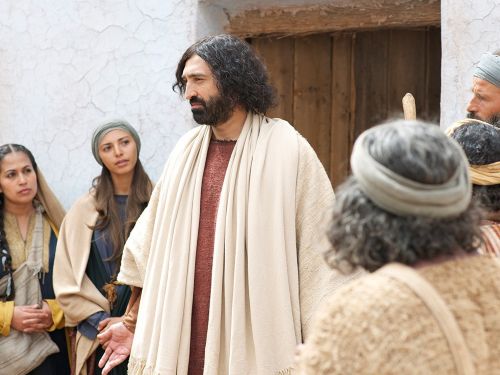
Courtesy of Lumo Project Films – www.lumoproject.com
Women were clearly not bystanders, wealthy woman provided physically and financially for Jesus and his disciples. Can these women so involved with Jesus legitimately be called disciples?
Martha is portrayed in a typical female role while her sister occupied a traditionally male position as a disciple and learner at the feet of Jesus. To sit at a rabbi’s feet was an expression that described a student who remained with their teacher day and night listening, learning and observing. In Acts 22:3, Paul uses this same expression to boast of his advanced rabbinic education “at the feet of Gamaliel.”
In a culture in which women were devalued and exploited, Jesus elevated women to equal status with men and recognised their faith to be his disciples. His response to Martha’s complaint was countercultural: “Mary has chosen what is better, and it will not be taken away from her.” [Luke 10:42] Mary’s choice was bold and must be understood against the backdrop of a time when women were excluded from formal religious study.
From a cultural perspective, Martha had good reason to be upset with her sister. Women didn’t mingle openly with men, and relations between men and women, even brothers and sisters are still highly regulated in some societies. Women congregated together, prepared meals and attended to household duties, they ate separately even when a guest of honour was present. So, Martha is not only asking that her sister be told to help her with the logistics of having guests, but she also wanted to see Jesus put Mary in ‘her place.’ The subtleties in scripture are what make the stories so compelling; Martha clearly thought Mary was out of line.
How did Jesus respond?
He reversed societal expectation and affirmed that Mary had chosen “the good part.” The Greek text doesn’t say her choice was better, it says she chose the “good portion.” “The good portion” in Jewish writings and academia, refers to ‘the goodness of Torah study.’ Students prayed at the beginning of their lesson: “Yahweh, give us our portion in your Torah,” and when the teaching concluded they prayed thanking God for one’s “portion.” An example the Jerusalem Talmud. (Berakhot 4:2) - “I thank thee, Lord my God, God of my fathers, that you set my portion with those who sit in the study hall and the synagogues, and you did not set my portion with those who sit in the theatres and circuses.” And from the Mishnah, (Avot 5:2) “Turn it over and over because everything is in it. And reflect upon it and grow old and worn in it and do not leave it, for you have no better portion than this.” To be a student and learn as a follower of Jesus was the “good portion” Mary chose the good portion but let us not fail to register the astonishment those present must have felt when Jesus affirmed her choice.
In a patriarchal society a woman’s place was not listening and learning but serving, staying quiet and out of the way. Throughout his ministry Jesus overturned the cultural expectation of females and opened new possibilities for women, slaves, ethnic minorities, Samaritans, sick and disabled people and the poor.
According to contemporary scholarship, Mary Magdalene was not a prostitute, she was an influential and prominent disciple of Jesus and destined to become a leader in the early Christian movement. In Luke’s second work, the Acts of the Apostles women held significant leadership and teaching roles that endured until Constantine’s institutional church when the female influence was largely and systematically written out of history.
The conversation between Jesus and Martha and his approval of Mary’s decision to become his disciple has implications far beyond devotion and priorities. The struggle for women’s rights still is ongoing in modern society and in some cultures has regressed. South Sudan is one of the most gender-unequal nations in the world with 76% of girls out of school – the worst in the world. In Afghanistan, secondary and higher education is strictly forbidden to girls and women. According to UNESCO data recently published, 1.4 million Afghan girls are deprived of schooling. In Yemen, women and girls are enduring a desperate humanitarian and rights crisis, and the same applies to females in sub-Sahara Africia where roughly 9 million primary school aged girls are deprived an education. Globally 130 million girls are out of school due to a combination of traditional roles, discrimination, conflict, and lack of resources.
Women are still struggling for what Mary was commended for - the opportunity to seek knowledge and gain an education. The backdrop of the gospel stories hints at breaking down patriarchal thinking and coercive systems that air-brushed stories of women’s roles in the church. Too often biblical stories have been interpreted in ways that have perpetuated the suppression of women and dictated the way they live their lives.
Looking more closely at the New Testament’s treatment of women, we see a different story than has been historically portrayed. The Mary and Martha story was the beginning of women exercising leadership based on knowledge, education, spiritual growth and gifting unhindered by gender, race and status